MH Energy Your Better Solar and Energy Partner

Solar Battery Storage lets a home or business keep electricity for use later. In a typical solar setup, panels produce direct-current power, while an inverter converts it into alternating current for household appliances. When production exceeds demand, a compatible battery may charge with the surplus. After sunset, or during a grid outage if the system supports backup operation, stored energy can power selected circuits. The battery, inverter, controls, and electrical panel work together. It is a practical system, not a magic one.
The exact operation depends on the equipment and its settings. Some systems prioritize charging the battery; others may send excess power to the grid. Capacity affects how much energy can be stored, while power rating affects how many devices can run at once. A refrigerator and a few lights may be manageable; an electric oven and heating system can demand much more. Details matter. Battery chemistry, temperature, installation quality, and age can also influence performance. A battery’s advertised capacity does not always equal the energy available to use.
Understanding Solar Battery Storage means looking beyond the battery itself. Check which loads the system can support, how long backup may last, and whether the system can operate during an outage. Local conditions and utility arrangements vary, so product specifications and qualified installation advice are important. One detail is easy to overlook: storing solar energy can improve flexibility, but it does not guarantee energy independence. The numbers deserve a careful look.
Solar battery storage is a rechargeable system that keeps some electricity generated by rooftop solar panels for later use. A battery stores energy, not sunlight. Inside, chemical reactions hold electrical energy until the home needs it. Many residential systems use lithium-ion batteries, though other battery types are available. Their capacity is measured in kilowatt-hours, or kWh, which indicates how much energy they can store.
During sunny hours, panels may produce more electricity than a home is using. The system can send that surplus to the battery instead of using it immediately. Later, stored energy can help run lights, a refrigerator, or other connected loads when panels produce little or no power. An inverter manages the flow and converts electricity into a form household appliances can use. Some energy is lost during charging and discharging, so the usable amount is lower than the battery’s stated capacity. Not every system supplies power during an outage; that depends on its design and settings.
Tips: Check both capacity and power ratings. Capacity describes stored energy; power affects how many appliances can run at once. Think about evening use, too. A battery is not a perfect backup, and its reserve settings can limit what is available.
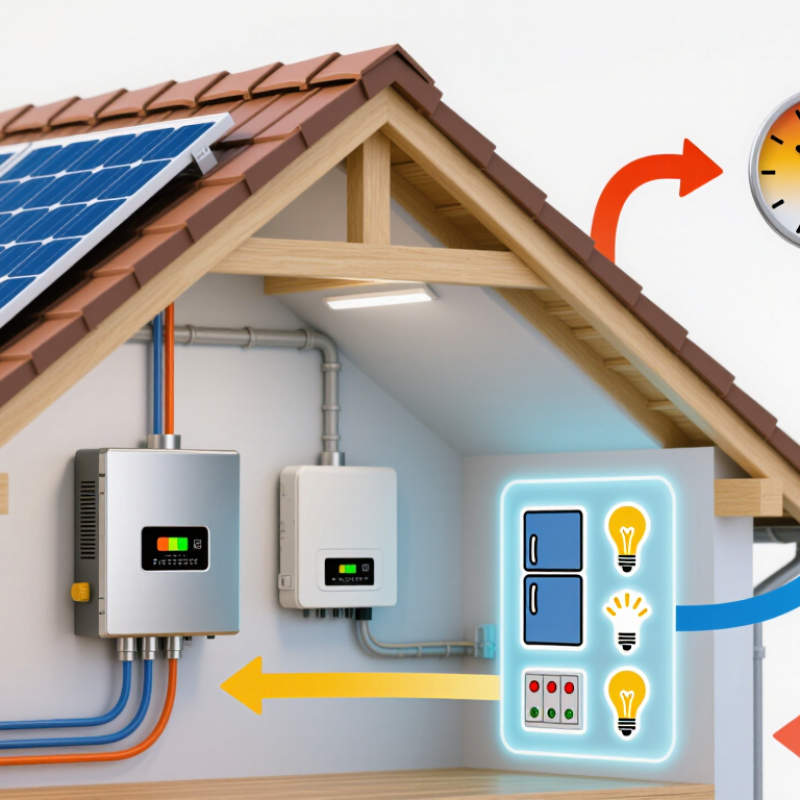
A solar battery system links photovoltaic panels, power electronics, storage cells, and controls. Panels produce direct-current electricity. An inverter converts it to alternating current for household circuits, while a hybrid inverter can also direct surplus power into the battery. Some systems use a separate charge controller to regulate charging. Small losses matter.
Inside the battery, cells store energy, and a battery management system monitors voltage, temperature, and charging limits. Disconnect switches and protective equipment help isolate the system during maintenance or faults. An energy management system decides when to serve household loads, charge the battery, or draw from the grid. On a sunny afternoon, for example, it may store excess rooftop generation for evening lights and cooking.
Performance depends on more than battery capacity. NREL’s 2024 Annual Technology Baseline uses about 85% round-trip efficiency for modeled lithium-ion storage; that utility-scale benchmark is not a promise for every home system. Conversion losses, temperature, and operating settings matter. Real installations are less tidy than diagrams, and controls can be hard to interpret. Checking equipment specifications and installer commissioning records helps verify how each component is configured.
| Component | What It Does | How It Works in the System | Practical Considerations |
|---|---|---|---|
| Solar panels | Convert sunlight into direct-current (DC) electricity. | The electricity can supply household loads, charge a battery, or be converted for use by AC appliances. | Solar production varies with sunlight, weather, shading, panel orientation, and system size. |
| Solar inverter or hybrid inverter | Converts DC electricity into alternating-current (AC) electricity used by most household circuits. | A hybrid inverter can coordinate power from solar panels, the battery, and the home. Some systems use separate inverters instead. | Compatibility depends on the battery and system design. Inverters have conversion losses and operating limits. |
| Battery cells and battery pack | Store electrical energy in chemical form for later use. | When solar generation exceeds immediate demand, the system can send surplus electricity to the battery. Stored energy is converted back to electricity when needed. | Usable capacity, power output, temperature range, and expected cycle life vary by battery chemistry and product design. |
| Battery management system (BMS) | Monitors and protects the battery pack. | It tracks conditions such as cell voltage and temperature and helps keep operation within the battery’s specified limits. | The BMS is commonly integrated into the battery; its functions and protection limits are system-specific. |
| Charge control and power conversion | Regulate how electricity flows into and out of the battery. | Depending on the system, these functions may be built into a hybrid inverter, a dedicated charge controller, or other power electronics. | Not every system has a separate charge controller. The equipment must match the battery and solar system configuration. |
| Energy management system | Monitors energy flows and controls system operation. | It can prioritize household use, battery charging, battery discharge, or grid exchange according to system settings and available power. | Available operating modes depend on the equipment, utility rules, and whether the system is configured for backup. |
| Metering and monitoring | Measure or display electricity production, consumption, and battery status. | Data from meters, sensors, and system electronics can help the controller decide when to charge or discharge and let users track performance. | Monitoring detail and accuracy depend on the sensors and system configuration. |
| Protection devices and disconnects | Help protect equipment and provide a means to isolate parts of the system for service or emergencies. | Fuses, circuit breakers, and disconnect switches are selected and installed for the relevant electrical circuits and local requirements. | Design and installation should follow applicable electrical codes and be completed by qualified professionals. |
| Enclosure and mounting | Support and protect the battery and associated equipment. | The battery is installed in an approved location and enclosure suited to its design and operating conditions. | Location requirements can include temperature limits, clearances, ventilation, and protection from moisture or physical damage. |
Typical operation: Solar panels generate DC electricity; power electronics direct it to household use, battery charging, or conversion to AC. When solar production is insufficient, stored battery energy can supply compatible loads. Exact power flows depend on whether the system is DC-coupled or AC-coupled, its settings, and whether it is designed for backup.
Sunlight reaching a solar panel creates direct-current electricity. The amount changes with cloud cover, shade, panel angle, and time of day. A charge controller helps regulate electricity flowing toward the battery, protecting it from unsuitable charging conditions. Some systems use a hybrid inverter to manage both household power and battery charging.
Here is the basic path. When the panels produce more electricity than the home is using, the system can send the surplus to the battery. At night, or during a shortfall, stored energy flows back through an inverter, which converts it into alternating current for ordinary appliances.
The battery’s management system monitors factors such as voltage and temperature. It may limit charging or output to help keep operation within safe ranges.
The simple version leaves out a few details. Conversion and storage involve energy losses, so the electricity later available is usually less than the surplus originally sent to the battery. The result depends on equipment, settings, and conditions. On a dim winter afternoon, for example, panels may not make enough power to fully recharge a battery. It’s not magic. Tracking daily generation and use can reveal whether the system is meeting a household’s needs.
When sunlight fades, a home’s electricity needs do not. A solar battery stores extra power produced during the day, then sends it back when panels produce less. The battery does not usually power household appliances directly. An inverter converts its stored electricity into the form a home can use.
During daylight, panels may supply the home while surplus energy charges the battery. In the evening, the inverter draws on that stored energy for lights, a refrigerator, or other connected circuits. That detail matters. A battery’s capacity describes how much energy it stores, while its power rating affects how many appliances it can run at once.
If the utility grid goes down, a battery can keep selected circuits running, but only if the system is designed for backup operation. Not every setup automatically powers the whole house. A refrigerator and a few lights may be manageable; an electric heater can drain stored energy quickly. No magic here. Battery performance also varies with temperature, age, and household use. A useful plan starts with the appliances you actually need, not just the biggest capacity number.
An illustrative 24-hour home energy profile: solar power supplies the home during daylight and charges the battery when production exceeds demand. After sunset, stored electricity can power the home.
Example profile for explanation only; actual production, consumption, and battery charge vary by home, weather, system size, and season. If the battery is depleted or demand exceeds available power, the home can draw electricity from the grid.
Solar batteries store surplus electricity for use after sunset or during an outage. Lithium iron phosphate batteries are widely used in home systems because they offer long cycle life and stable operation. Other lithium-ion chemistries can provide compact storage, while lead-acid batteries may cost less upfront but usually need more space and replacement sooner. Chemistry matters. So does the usable capacity, not just the advertised total.
Match battery capacity to evening use, essential loads, and expected backup hours. A family that runs a refrigerator, lights, and a small pump needs a different setup from one powering heating equipment. Check whether the battery and inverter are compatible, and whether the system can expand later. Location matters: garages can become hot, while outdoor units need protection from weather. A qualified installer should confirm ventilation, wiring, controls, and local safety requirements. Keep clear records of settings and maintenance. One detail homeowners sometimes overlook is standby power; small constant loads can drain a battery overnight. Estimates are imperfect, too. Actual storage depends on weather, household habits, and battery age.